
AI is getting better at understanding humans.
The bigger question for CMOs and brand leaders is whether humans are getting better at understanding each other.
We’re in a strange moment in marketing. Technology can analyze more data, generate more content, personalize more experiences, and accelerate more decisions than ever before. AI can turn hours of work into minutes and help marketers see patterns that would have been nearly impossible to find manually.
And yet, the brands that win won’t necessarily be the ones using the most AI.
They’ll be the ones using technology to create better human connections.
That distinction matters.
I’ve spent more than two decades helping companies navigate technology, marketing, brand strategy and transformation. I’ve watched “digital” go from a differentiator to an expectation. I think AI is following a similar path.
Eventually, nobody will care that your company uses AI.
They’ll care what it helped you do.
AI changes the work. It doesn’t change the job.
The job of marketing has always been to understand people well enough to create movement.
Technology gives us better ways to do that.
AI can help us find patterns in customer behavior. It can make personalization practical at scale. It can turn massive amounts of information into useful insight. It can help us create content that is discoverable across traditional search and AI-powered platforms.
But AI cannot answer the most important questions for us:
Are we solving the right problem?
Are we solving it in a way people actually care about?
Why should someone believe us?
What makes this brand feel different?
Those remain fundamentally human questions.
This is where I think a lot of marketing organizations are getting distracted.
We’re measuring AI adoption, content volume, automation and efficiency.
Those things matter.
But activity is not momentum.
The CMO’s job is changing.
For CMOs, AI creates an interesting tension.
On one side, there is enormous pressure to move faster, automate more and demonstrate efficiency.
On the other, brands are facing more noise, more sameness and more skepticism.
AI can make the first problem easier while making the second one worse.
If everyone can generate ten times more content, we don’t have a content shortage.
We have an attention and differentiation problem.
That means the CMO increasingly has to be the person asking:
What should we automate?
What should remain deeply human?
Where does technology create a better customer experience?
Where does it simply create more noise?
Are we using AI to improve an outcome—or just to say we’re using AI?
I’ve talked about this before as AI washing. Too many brands are putting “AI” into products, positioning and messaging because they believe they need to look modern.
But buyers don’t buy AI.
They buy outcomes.
If AI helps a customer save four hours, make a better decision, shorten a sales cycle or receive a more relevant experience, tell me that.
That is marketing.
The technology is the mechanism—not the message.
The most interesting opportunity is the connection between human insight and machine intelligence
This is where I think the next era of marketing gets really interesting.
Consider zero-party data.
Instead of marketers trying to infer what a prospect wants from increasingly complicated signals, we can create valuable interactions where people voluntarily tell us what matters to them.
A prospect answers a few questions.
They identify a challenge.
They tell us their priorities.
They share what they’re trying to accomplish.
In return, the brand gives them something genuinely useful—perhaps a personalized assessment, recommendation, report or roadmap.
That is an exchange of value.
And AI makes that exchange dramatically more powerful.
The machine can take what a person tells us and reorganize an enormous knowledge base around that individual’s priorities.
Now marketing isn’t simply broadcasting a message.
It is responding.
That is the human-AI connection I’m most interested in.
Not replacing the human.
Understanding the human better.
What this means for brand leaders?
I think there are three shifts every CMO should be thinking about.
1. Stop marketing the technology. Market the outcome.
If your headline starts with your technology stack, AI model or automation capability, ask whether your customer actually cares.
Lead with the problem you solve.
Then explain how technology makes the solution better.
2. Use AI to create more relevant human experiences—not more content
We don’t need another thousand generic blog posts.
We need content that helps someone make a decision.
We need experiences that recognize what a buyer actually cares about.
We need strong opinions, useful comparisons, real answers, credible expertise and content that works wherever buyers are researching—including AI-powered search.
The goal isn’t more content.
The goal is movement.
3. Build your marketing around what customers tell you
Your sales team already has a discovery process.
Your customers are already telling your people what problems they need solved.
Your marketing should capture more of that intelligence earlier.
That is where zero-party data becomes powerful.
It can help turn marketing from a guessing game into a conversation—and AI can help scale the conversation without stripping away its relevance.
The human advantage isn’t disappearing
If anything, I think it becomes more valuable.
As machines become better at generating, analyzing and optimizing, human judgment becomes the differentiator.
Creativity.
Empathy.
Curiosity.
Taste.
Strategy.
Courage.
The ability to understand what people actually want—not simply what the data says they might want.
AI can accelerate activity.
Strategy creates momentum.
And the brands that figure out how to combine machine intelligence with human understanding will have a significant advantage.
That’s the opportunity I see for CMOs right now.
Don’t ask, “How do we use more AI?”
Ask:
“How can AI help us understand our customers better, create more value for them, and move them forward?”
That’s a much better question.
And probably a much better growth strategy.
The future of B2B marketing isn’t human versus AI.
It’s human with AI.
And the winners will know the difference.
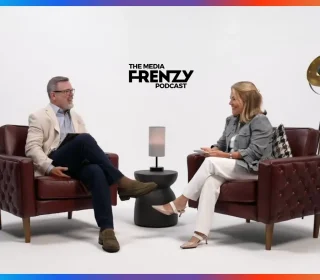
— David McMullen
President, Media Frenzy Global
Atlanta Marketer of the Year | Brand, Marketing & Martech Strategist